 Original illustration
Vented narrow bottle
Dr. Brown’s Anti-Colic Options+
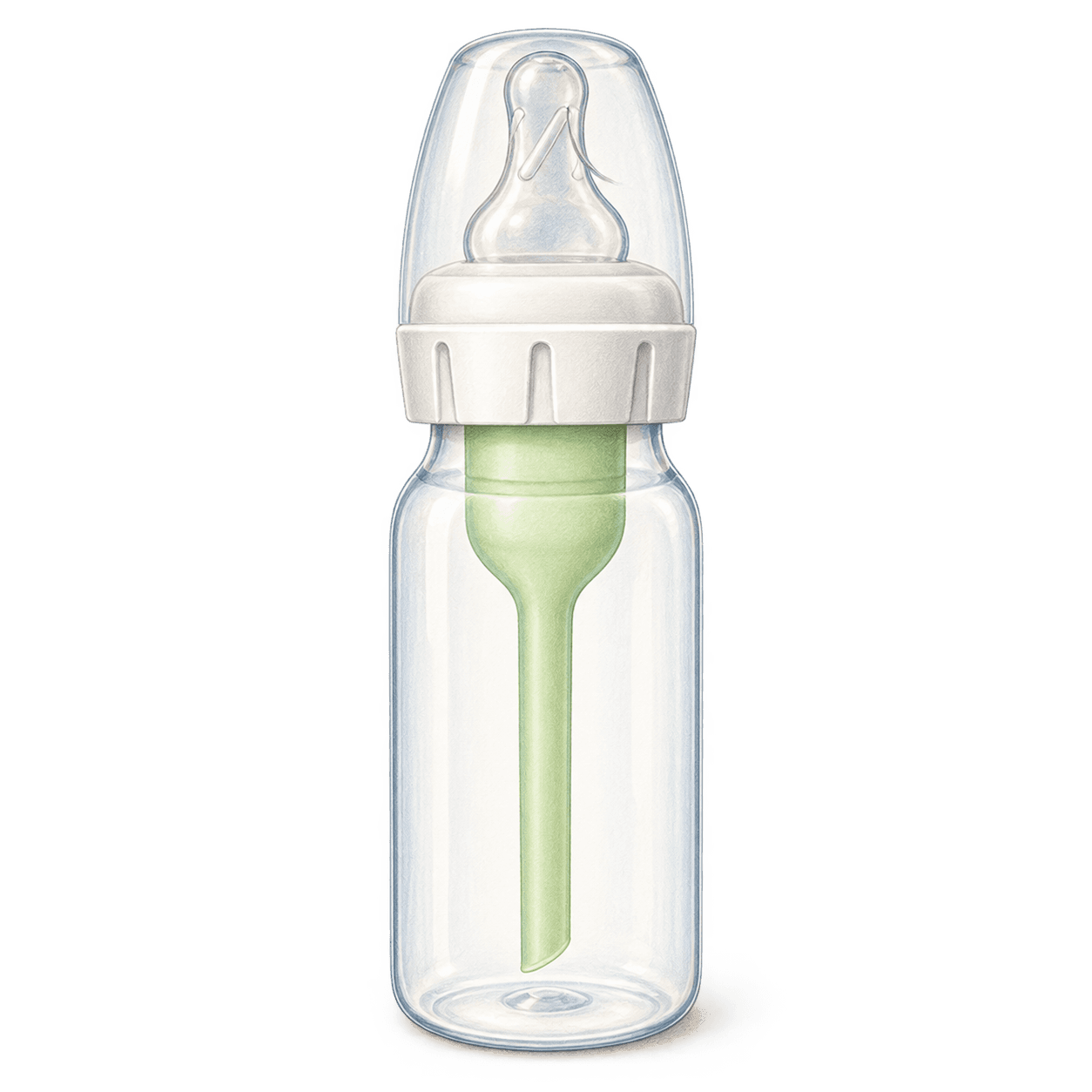
A 4 oz narrow bottle with a removable internal vent. It is a useful first test if gas or a collapsing nipple is part of the problem.
Quick bottle picks
Affiliate disclosure: As an Amazon Associate I earn from qualifying purchases. Product links support this free guide at no additional cost to you.
Original illustrationVented narrow bottle
A 4 oz narrow bottle with a removable internal vent. It is a useful first test if gas or a collapsing nipple is part of the problem.
 Original illustration
Wide-neck bottle
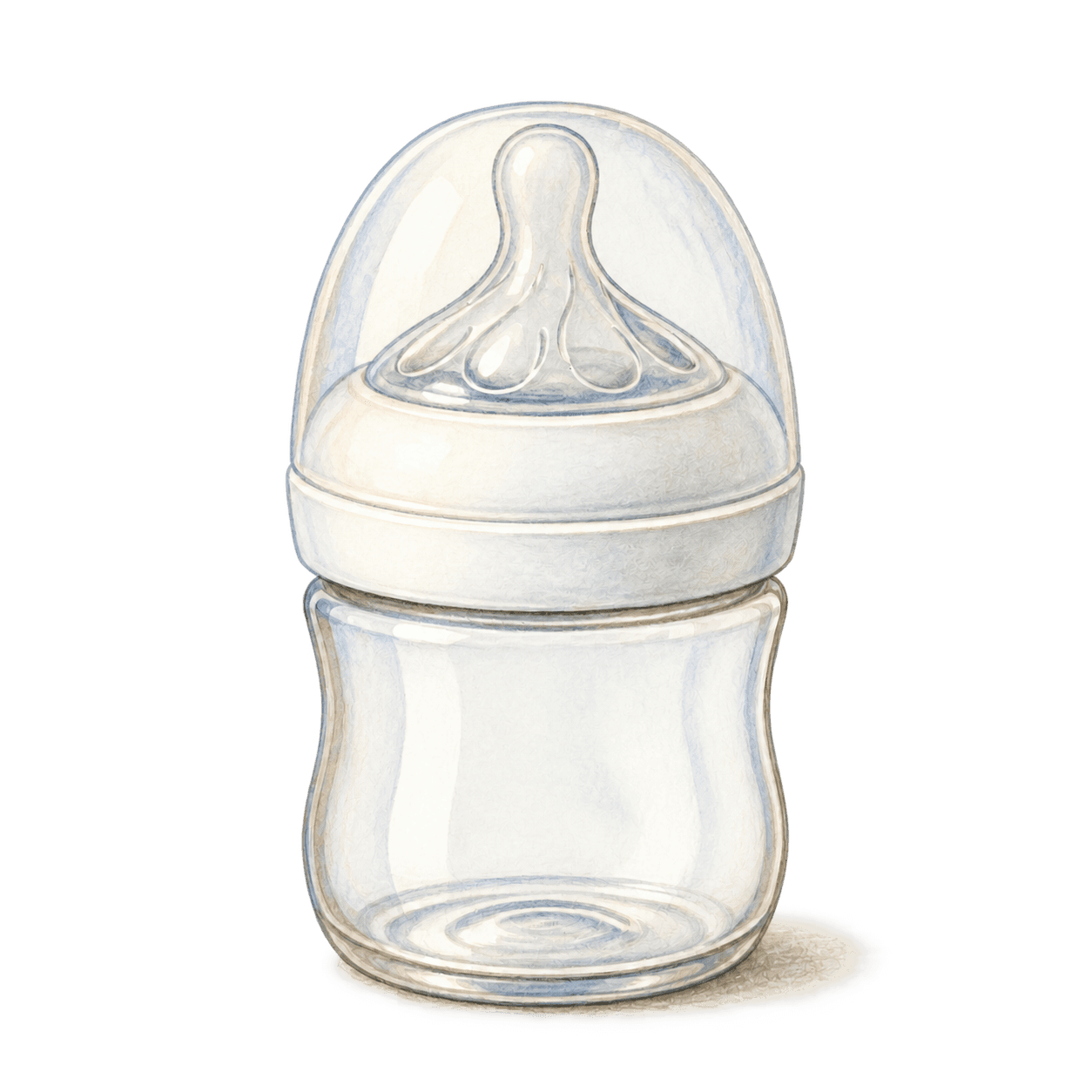
A 4 oz wide-neck bottle with fewer internal pieces. It gives you a simple way to test a broader nipple base.
 Original illustration
Optional convenience
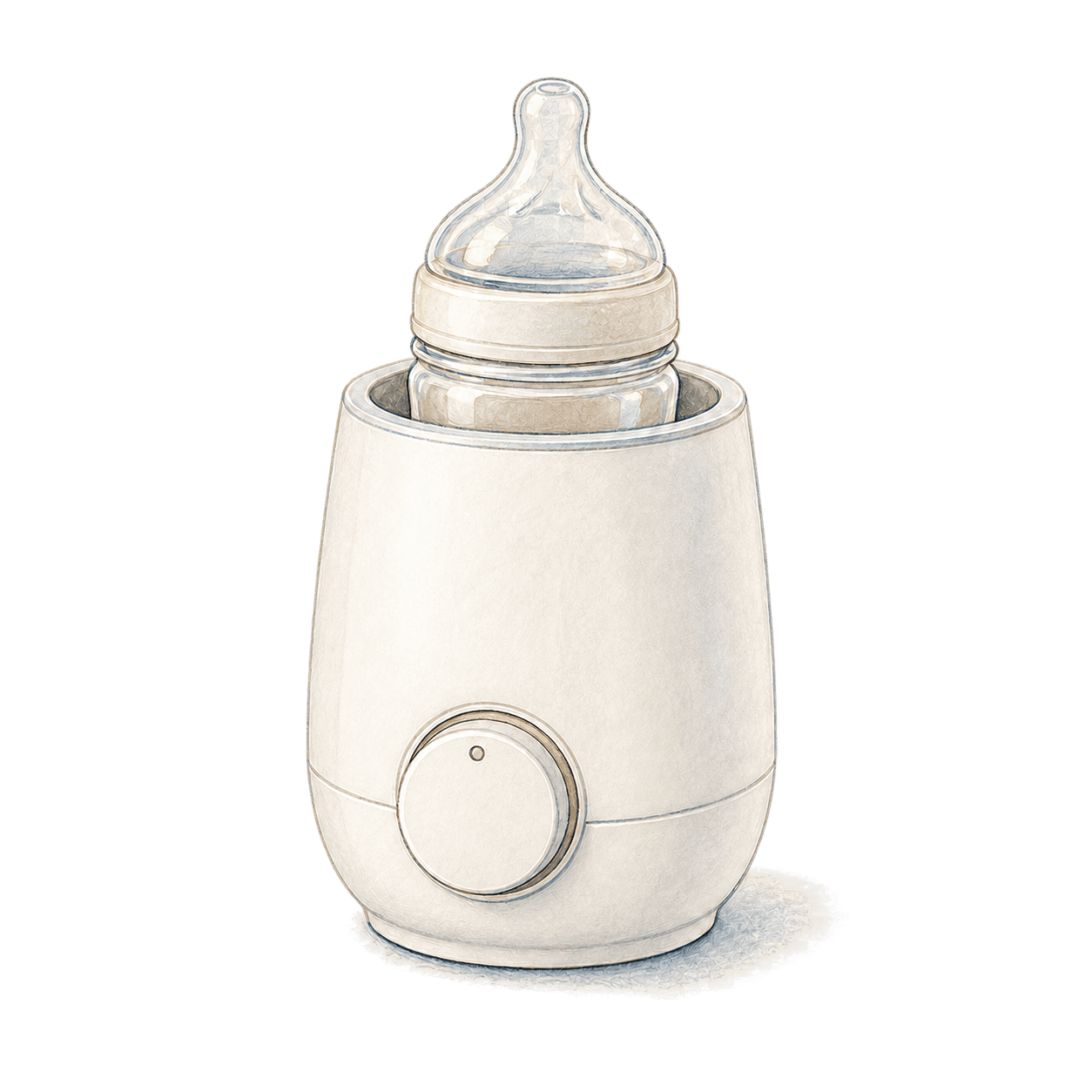
A countertop warmer for refrigerated milk. It can make overnight feeds more predictable, but it is a convenience rather than a feeding need.
Editorial trust
Written by the Baby Milk Calculator editorial team and reviewed against primary public-health guidance. This page is for general education, not individualized diagnosis or treatment.
Last content update
August 26, 2026
Primary sources
9 official references
Written by
Baby Milk Calculator editorial team
Reviewed against
Guidance from AAP, Advances in Neonatal Care, American Journal of Speech-Language Pathology, Nature Food, FDA, and CDC
Good for
General reference and planning
Sources inform this guide. Citing an organization does not mean it authored, reviewed, or endorsed this page. See our editorial policy for how we use references and handle corrections.
Begin with flow rate, or how quickly milk leaves the nipple. If milk arrives faster than your baby can coordinate sucking, swallowing, and breathing, you may see gulping, coughing, or a struggle at the bottle. A nipple that is too slow can turn the same feed into a long, tiring effort.
Researchers have measured these differences. A 2015 study in the American Journal of Speech-Language Pathologytested 10 samples of each of 29 nipple types. The slowest measured 2.10 ml/min; the fastest measured 85.34 ml/min. In 2019, a second study tested 375 individual nipples across 25 hospital and retail products and found rates from 0.86 to 37.61 ml/min.
The numbers also show why brand labels need context. Flow levels are not standardized, so one company's slow nipple can be faster than another company's medium. The studies found differences between samples of the same product too. The label is a starting point, not a guarantee.
When you shop
Treat each brand's flow levels as its own system. A level 1 is only useful for comparison with other nipples from that brand.
Start with the slowest reasonable option, then watch an ordinary feed before deciding to move up.
Use this table as a starting point, not a schedule. Let feeding behavior guide nipple flow, and let the usual amount per feed guide bottle size. The volume ranges use the same weight-based intake estimate as the Baby Milk Calculator (roughly 150 ml per kilogram per day, divided among feeds).
| Stage | Typical flow label | Per feed | A good fit looks like |
|---|---|---|---|
| 0–1 month | Newborn / level 0 / level 1 (slowest available) | 1.5–3 oz · 45–90 ml | Rhythmic suck-swallow-breathe, frequent self-paced pauses, feed lasting 15–20 min |
| 1–3 months | Slow flow, often still level 1 | 3–5 oz · 90–150 ml | Feeds settle to 15–20 min as the baby gets stronger; no need to size up on age alone |
| 3–6 months | Slow to medium (level 1–2) | 4–6 oz · 120–180 ml | Move up only if feeds drag past 30 min or the baby tires before finishing |
| 6–9 months | Medium (level 2–3) | 6–8 oz · 180–240 ml | Efficient 10–15 min feeds; solids begin, so total bottle volume starts to plateau |
| 9–12 months | Medium to fast (level 3), or stay put | 6–8 oz · 180–240 ml | Many babies never need the fastest level; cup practice matters more than nipple size now |
| Preterm / low tone | Extra slow, often a hospital-issue nipple | Per NICU or clinical feeding plan | Guided by a neonatal team or feeding therapist — flow control is a clinical decision here |
Many babies do not use every flow level. If feeds are calm and efficient, there is no reason to change a nipple simply because your baby reached the next age range.
Watch one ordinary feed. With a comfortable flow, your baby can suck, swallow, breathe, and pause without rushing to keep up. Young infants often finish in about 15 to 20 minutes, although the pattern matters more than the stopwatch.
Signs the flow is too fast: coughing, spluttering, gulping, leaking milk, wide eyes, splayed fingers, fast breathing, or repeatedly pulling away to recover. A feed that ends in only a few minutes can also point to a flow that is too fast.
Signs the flow is too slow: feeds that regularly run past 30 minutes, the nipple collapses under suction, your baby tires before finishing, or becomes frustrated while milk remains in the bottle.
Before buying another nipple, try paced bottle feeding. Hold your baby more upright, keep the bottle closer to horizontal, and pause every 20 to 30 seconds. That gives your baby more control over the pace and may solve the problem on its own.
Think about the bottle you will hold, wash, pack, and sometimes drop. Plastic is light and inexpensive. Glass is easy to see through and avoids plastic contact, but it is heavier. Silicone and stainless steel solve different problems at a higher price. No material is best in every situation.
| Material | Weight | Durability | Heat tolerance | Main tradeoff |
|---|---|---|---|---|
| Polypropylene (PP) plastic | Lightest | Unbreakable; clouds and scratches over time | Dishwasher and sterilizer safe, but degrades with repeated heat | Lowest-cost option and easy to hold; the material used in the microplastics study below |
| Glass | 2–3× heavier | Will not scratch or stain; can shatter if dropped | Tolerates repeated boiling and sterilizing indefinitely | Avoids plastic contact and lasts well; heavier for caregivers and self-feeding babies |
| Silicone | Light, squeezable | Very durable; can pick up odors over time | Stable at high temperature; fully sterilizable | Soft, squeezable body; volume markings can be harder to read and the price is higher |
| Stainless steel | Mid-weight | Effectively indestructible | Sterilizes well; retains temperature longer | Opaque, so you cannot see the milk level mid-feed; highest upfront cost |
| PPSU / PES | Light, like PP | Amber-tinted, resists clouding better than PP | Rated for far more sterilizing cycles than PP | More heat-stable than PP and usually more expensive; still a plastic food-contact surface |
A 2020 Nature Foodstudy tested polypropylene infant bottles prepared with the World Health Organization's sterilizing and mixing procedure. Across the experiments, bottles released from thousands to 16.2 million particles per liter. The authors modeled infant exposure across 48 regions and estimated a broad range of roughly 14,600 to 4.55 million particles per day, depending on local feeding practices.
Heat made the biggest practical difference: higher-temperature water and repeated heat exposure increased particle release. If you use plastic, the following steps can limit unnecessary heat and wear without changing safe formula preparation.
This was a particle-release study, not a study of infant health outcomes, so it does not tell us whether these amounts affect a baby's health. Families who prefer to avoid plastic contact can choose glass or stainless steel. If you use plastic, follow the bottle maker's care instructions and the formula's preparation directions.
In 2012, the FDA amended its regulations so they no longer provide for BPA-based polycarbonate resins in baby bottles and sippy cups. A 2013 amendment did the same for BPA-based epoxy resins in infant formula packaging.
For a new U.S. bottle, “BPA-free” is expected rather than a special feature. Be more cautious with old, secondhand plastic bottles if you cannot identify when they were made or what they are made from.
Standard narrow nipples sit on a slim bottle neck and usually have a longer, tapered tip. They are widely stocked and tend to cost less.
Wide-neck or breast-shaped nipples have a broad base. They are often suggested for breastfed babies because the shape encourages a wider mouth opening, but evidence that a particular shape prevents “nipple confusion” is weak. Some babies prefer them; others do not.
Orthodontic nipples have a flattened or angled tip. Claims about palate development are not well supported. Choose one if your baby feeds comfortably with it, not because the shape promises a developmental advantage.
Most nipples are silicone. It is clear, firm, and durable. Latex is softer and more flexible, but it wears faster and is not suitable for a baby with latex sensitivity. When in doubt, silicone is the simpler starting choice.
Also check how the bottle vents. Without a working vent, a vacuum can build as milk leaves the bottle, slowing the flow and sometimes collapsing the nipple. The vent may sit in the nipple collar, the bottle base, or a removable internal tube.
The “anti-colic” label usually describes one of three vent designs. The main difference for parents is how many parts need washing.
A working vent keeps flow steadier and may reduce the air a baby swallows. That does not make the bottle a treatment for colic. Colic often peaks at about six weeks and improves by three to four months, so improvement can also reflect its normal course.
It is reasonable to try one vented bottle for a gassy baby. If crying is severe, feeds are regularly distressing, or weight gain is a concern, talk with your pediatrician. The signs your baby is getting enough milk can help you check the broader feeding picture.
Newborn to 1 month. Start with a 4 to 5 oz (120 to 150 ml) bottle and the slowest nipple the brand makes. Most newborn feeds fit easily in that size, and the smaller bottle is easier to angle. Use paced feeding while suck-swallow-breathe coordination is still developing. The CDC recommends daily sanitizing, in addition to washing, for babies under 3 months, babies born prematurely, and babies with weakened immune systems.
1 to 3 months. If feeds are going well, keep the same setup. A 4 to 5 oz bottle still handles many feeds at this age. For a baby born preterm or following a clinical feeding plan, ask the neonatal team or feeding therapist about flow changes rather than relying on a retail chart. See the preemie feeding guide for that context.
3 to 6 months. Add a larger bottle when feeds regularly reach 5 to 6 oz. Some babies need a faster nipple in this period, but many do not. If feeding suddenly becomes difficult, try a quieter room too; distraction is common at this age.
6 to 9 months. Milk intake often levels off as solids begin. The AAP suggests introducing a cup around this time so your baby can practice. Babies may also start holding their own bottle, making weight and grip more noticeable.
9 to 12 months. Keep cup practice with meals and begin moving daytime milk to an open or straw cup. There is no need to buy the fastest nipple if the current one still works.
12 months and beyond. The AAP recommends finishing the move away from bottles between 12 and 18 months. Longer bottle use can crowd out iron-rich foods and increase tooth-decay risk, especially with long or bedtime feeds. The toddler whole milk guide covers what daily intake should look like once bottles are gone.
Practical starting points
These picks let you compare two common bottle designs without buying a cabinet full: one narrow bottle with a removable vent and one simpler wide-neck bottle. The warmer is separate and completely optional. Start with a small pack and watch how your baby feeds before committing to a full system.
Affiliate disclosure: As an Amazon Associate I earn from qualifying purchases. Product links support this free guide at no additional cost to you. The illustrations are original and are not official manufacturer product images.
Original illustrationVented narrow bottle
A 4 oz narrow bottle with a removable internal vent. It is a useful first test if gas or a collapsing nipple is part of the problem.
Original illustrationWide-neck bottle
A 4 oz wide-neck bottle with fewer internal pieces. It gives you a simple way to test a broader nipple base.
Original illustrationOptional convenience
A countertop warmer for refrigerated milk. It can make overnight feeds more predictable, but it is a convenience rather than a feeding need.
A registry-sized set is tempting, but reviews cannot tell you which nipple your baby will accept. Buy two or three small bottles first. Once one works, use the table to build out a set that matches how often you bottle-feed and wash dishes.
| Feeding pattern | Bottles | Size | Why |
|---|---|---|---|
| Exclusive bottle feeding | 8–10 | 4–5 oz to start, 8–9 oz from ~4 months | Enough to cover a full day and wash once |
| Combination feeding | 4–6 | 4–5 oz early, 6–8 oz later | Covers the bottle feeds without a daily wash cycle |
| Occasional bottles | 3–4 | 4–5 oz | Enough for a caregiver shift or an evening out |
| Before you commit | 2–3 | Smallest available | Test nipple acceptance from one or two brands first |
After every feed, take the bottle apart completely. Wash the bottle, nipple, ring, cap, and vent pieces in hot soapy water or in a dishwasher when the parts are dishwasher-safe. CDC guidance recommends a dedicated basin and brush instead of placing parts directly in the kitchen sink. Let everything air-dry on a clean towel or rack.
Cleaning and sanitizing are separate steps. Sanitize at least once a day for babies under 3 months, babies born prematurely, and babies with weakened immune systems. For healthy older babies, thorough cleaning is generally enough.
Check the nipple while you wash it. Damage can change the flow, so replace it if you notice any of these signs:
Many manufacturers suggest replacement every two to three months, but frequent use and heat can wear a nipple sooner. The condition of the nipple matters more than the calendar.
For a newborn, buy two or three 4 to 5 oz bottles from one or two designs, each with the slowest nipple available. That is enough to learn whether your baby prefers a narrow or wide base and whether a vent is useful.
Choose material for your routine: plastic for a light, inexpensive bottle; glass to avoid plastic contact; silicone for a soft, durable body; or stainless steel for long-term durability. A bottle warmer can be convenient, but milk does not have to be served warm.
Watch your baby during the feed before changing nipple flow. If feeds remain stressful, coughing or choking is frequent, or weight gain is a concern, ask your pediatrician or a feeding specialist for help. To estimate how much milk to put in the bottle, use the Baby Milk Calculator for a weight-based daily total and amount per feed in ml or oz.
Primary sources
These links are the main public-health and pediatric references used to maintain this guide.
01
Bottle Feeding BasicsHealthyChildren.org / American Academy of Pediatrics
AAP practical guidance on bottle and nipple selection, feeding position, and holding the bottle during a feed.
02
Introducing the BottleHealthyChildren.org / American Academy of Pediatrics
AAP guidance on when and how to introduce a bottle to a breastfed baby, including nipple choice and pacing.
03
Discontinuing the BottleHealthyChildren.org / American Academy of Pediatrics
AAP timeline for moving from bottle to cup, starting around 6 months and completing between 12 and 18 months.
04
Know the Flow: Milk Flow Rates From Bottle Nipples Used in the Hospital and After Discharge (Pados et al., 2019)Advances in Neonatal Care
Bench measurement of 25 nipple types showing flow rates from 0.86 to 37.61 ml/min and package labels that do not track measured flow.
05
Milk Flow Rates From Bottle Nipples Used for Feeding Infants Who Are Hospitalized (Pados et al., 2015)American Journal of Speech-Language Pathology
Testing of 29 nipple types finding a roughly 40-fold spread in flow rate and wide unit-to-unit variability within a single product.
06
Microplastic Release From the Degradation of Polypropylene Feeding Bottles During Infant Formula Preparation (Li et al., 2020)Nature Food
Quantifies microplastic release from polypropylene bottles prepared under WHO conditions and the strong effect of water temperature.
07
Bisphenol A (BPA): Use in Food Contact ApplicationU.S. Food and Drug Administration
FDA record of the 2012 and 2013 rule changes that removed BPA-based polycarbonate and epoxy resins from baby bottles, sippy cups, and infant formula packaging.
08
How to Clean, Sanitize, and Store Infant Feeding ItemsCDC
CDC feeding-item cleaning guidance, including extra sanitizing precautions for premature babies.
09
Is Your Baby Hungry or Full? Responsive Feeding ExplainedHealthyChildren.org / American Academy of Pediatrics
AAP explanation of infant hunger and fullness cues.
Begin with the slowest nipple that brand sells, usually called newborn, level 0, level 1, or extra slow. Those labels are not standardized across brands, so watch the feed: steady sucking and swallowing, easy breathing, and regular pauses are better signs of a good fit than the number on the package.
Change flow when the current nipple no longer works well, not when your baby reaches a date on the package. A faster flow may help if feeds regularly take more than 30 minutes, the nipple collapses, or your baby tires before finishing. Stay put or move back down if you see coughing, gulping, leaking milk, rapid breathing, or repeated pulling away.
Glass avoids plastic contact, resists scratches and odors, and handles repeated sterilizing well. It is also much heavier and can break. Polypropylene bottles are light, inexpensive, and hard to damage, but laboratory research has found microplastic release, especially with high heat. The better choice depends on which tradeoff matters more in your home.
The vent prevents a vacuum from building inside the bottle and may make feeding more comfortable for some gassy babies. Evidence that a particular bottle treats colic is much less convincing. Trying one vented bottle is reasonable; severe crying, painful feeds, or poor weight gain calls for a pediatric assessment.
Start with two or three small bottles while you learn which nipple your baby accepts. If bottle-feeding is going well, a practical full set is about 8 to 10 bottles for exclusive bottle feeding, 4 to 6 for combination feeding, or 3 to 4 for occasional use. Add larger bottles only when the usual feed no longer fits comfortably.
The American Academy of Pediatrics recommends offering a cup when solids begin, at about 6 months, and completing the move away from bottles between 12 and 18 months. Dropping one daytime bottle at a time is often easier than stopping all at once; many families leave the bedtime bottle until last.
Related reading
Use these supporting resources to answer the next question parents usually ask after this topic.
Professional comparison of ready-to-feed and powdered infant formula covering sterility and Cronobacter risk, cost per prepared ounce, preparation time, storage windows after opening, mixing accuracy, and which form public-health agencies recommend for higher-risk infants.
Read
Learn how much expressed breast milk to feed your baby using the 150 ml/kg/day rule, a per-feed lookup table for weights 3–7 kg, age-based ranges, and signs of adequate intake.
Read
Parent checklist for wet diapers, weight gain, stool patterns, and behavior cues that suggest adequate milk intake.
Read